

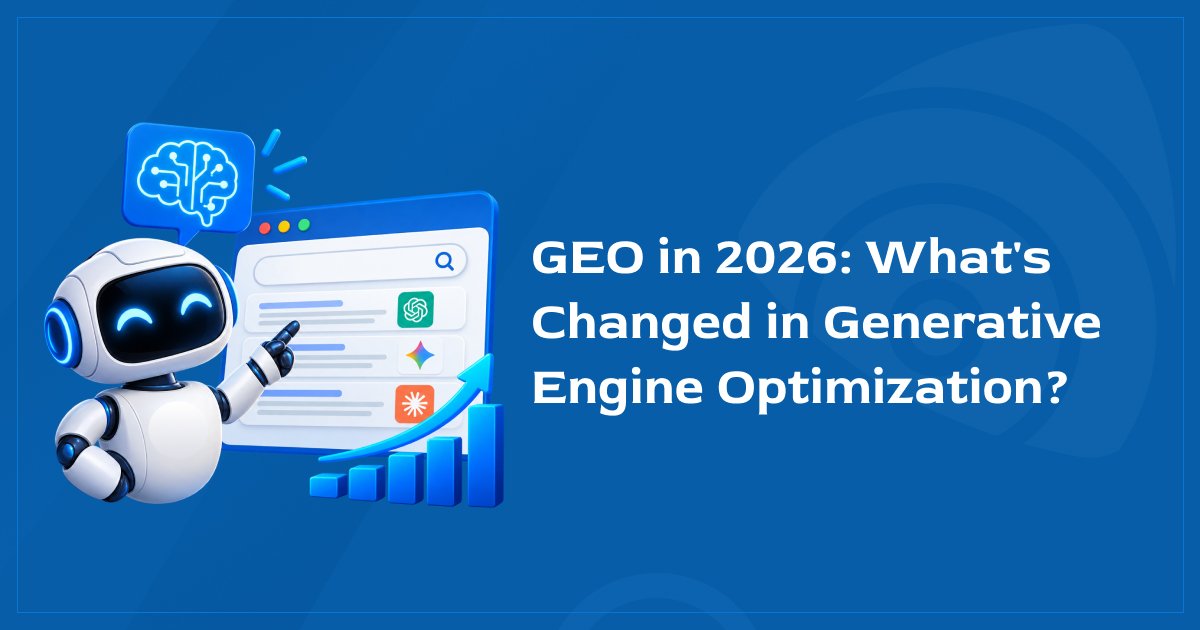
GEO in 2026: What's Changed in Generative Engine Optimization?
Generative Engine Optimization (GEO) is no longer a new concept, but it has evolved significantly in 2026. Google has introduced new AI Search capabilities, published dedicated guidance for optimizing websites for generative AI features, and clarified several misconceptions around GEO. Here's what has actually changed, and what businesses should focus on now.
Generative Engine Optimization (GEO) is no longer a new concept. Since AI-powered search began changing how people discover information online, businesses have been exploring how to make their brands visible in AI-generated answers.
But GEO has evolved significantly in 2026. Google has introduced new AI Search capabilities, published dedicated guidance for optimizing websites for generative AI features, and clarified several misconceptions around GEO. At the same time, new research is providing a clearer picture of how AI systems discover and cite brands.
So, what has actually changed in GEO, and what should businesses focus on now?
AI Search Is Becoming the New Discovery Layer
Traditional search usually starts with a keyword and produces a list of web pages. AI-powered search is increasingly conversational. Users can ask detailed questions, add follow-ups, combine different types of information, and receive synthesized answers with links to supporting sources.
Google reported in May 2026 that AI Mode had surpassed one billion monthly active users globally, with AI Mode queries more than doubling every quarter since its launch.
For businesses, this means online visibility is no longer only about where a website appears in traditional search results. It is also about whether a brand is understood, referenced, or cited when potential customers ask AI systems relevant questions.
Google Has Given GEO More Clarity
One of the biggest developments in 2026 is that Google has provided dedicated guidance for its generative AI search features.
The guidance reinforces an important point: GEO does not replace SEO.
Google continues to recommend the fundamentals of Search, including crawlable websites, useful content, strong page experience, internal linking, structured information, and people-first content. It also states that there are no special technical requirements or specific "GEO" markup needed to appear in AI Overviews or AI Mode.
This changes how businesses should approach GEO. Instead of searching for a shortcut to "rank in AI," the focus should be on building a website and digital presence that provides genuinely useful information.
The llms.txt Myth Is Losing Momentum
Another major clarification came in June 2026. There has been considerable discussion around llms.txt files as a way of making websites more accessible to AI systems. Google clarified that llms.txt is not needed for Google Search and does not affect visibility or rankings in Google Search.
For businesses, this is a useful reminder: GEO is not about implementing every new AI-related technical trend. The fundamentals still matter more.
AI Visibility Is Becoming More About Citations and Sources
Recent GEO research is also changing how marketers measure AI visibility.
A July 2026 study analyzing 860 AI-generated buyer answers across 85 B2B software companies found that AI responses referenced thousands of different domains. The study also found that vendor-authored content accounted for a large share of the citations it analyzed.
Other research has found that citation patterns vary considerably between AI platforms. YouTube, Wikipedia, Reddit, news publications, industry websites and other sources can all appear in AI-generated answers depending on the query and platform.
This means your website should not be the only thing you optimize. Your overall digital presence matters.
What Should Businesses Focus on in GEO Now?
1. Create Content Around Real Questions
Instead of creating articles only around keywords, answer the questions your customers actually ask.
For example, a digital marketing agency could create useful content around:
- How does SEO help a growing business?
- SEO vs paid advertising
- How does AI affect digital marketing?
- How can businesses improve their online visibility?
- What should a business consider before redesigning its website?
This approach aligns content with conversational search behaviour.
2. Build Genuine Topical Authority
Publishing dozens of generic AI-generated articles is unlikely to create meaningful authority.
Businesses should develop useful, connected content around their areas of expertise — including SEO, digital marketing, content marketing, branding, website development, AI solutions, and business technology.
Original insights, case studies, data, examples and expert perspectives can make content more valuable.
3. Strengthen Your Entire Digital Presence
GEO isn't limited to your website.
Relevant third-party mentions, reviews, industry publications, videos, business profiles and other authoritative sources can contribute to how a brand is represented across AI-powered search experiences.
The goal isn't to manufacture mentions. It's to build a consistent and credible online presence.
4. Keep SEO at the Core
The most important 2026 update may actually be that SEO remains important.
Google's current guidance makes it clear that existing SEO best practices continue to support visibility in its AI search features.
So businesses shouldn't think: SEO → GEO. Instead, think: SEO + Quality Content + Brand Authority + GEO.
The New Goal: Be Discoverable and Citable
GEO is moving from a theoretical marketing concept toward an ongoing part of digital visibility.
The objective isn't simply to make a brand "rank" in an AI answer. It is to make the brand's information clear, useful, trustworthy and relevant enough to be discovered and potentially referenced when customers ask questions.
For businesses investing in search engine optimization, digital marketing, content strategy, branding and website development, this means adapting to AI search without abandoning the fundamentals that made SEO effective.
The future of search isn't about choosing between SEO and GEO. It's about building a digital presence that works for both traditional search and the increasingly AI-powered way people discover information.
Ready to build a GEO-ready digital presence?
Book a Free Strategy Call